Most business owners assume their future clients type the company name into Google. It's a natural intuition — but it's rarely the reality, especially for a young or little-known brand.
You can't search for a brand you don't know
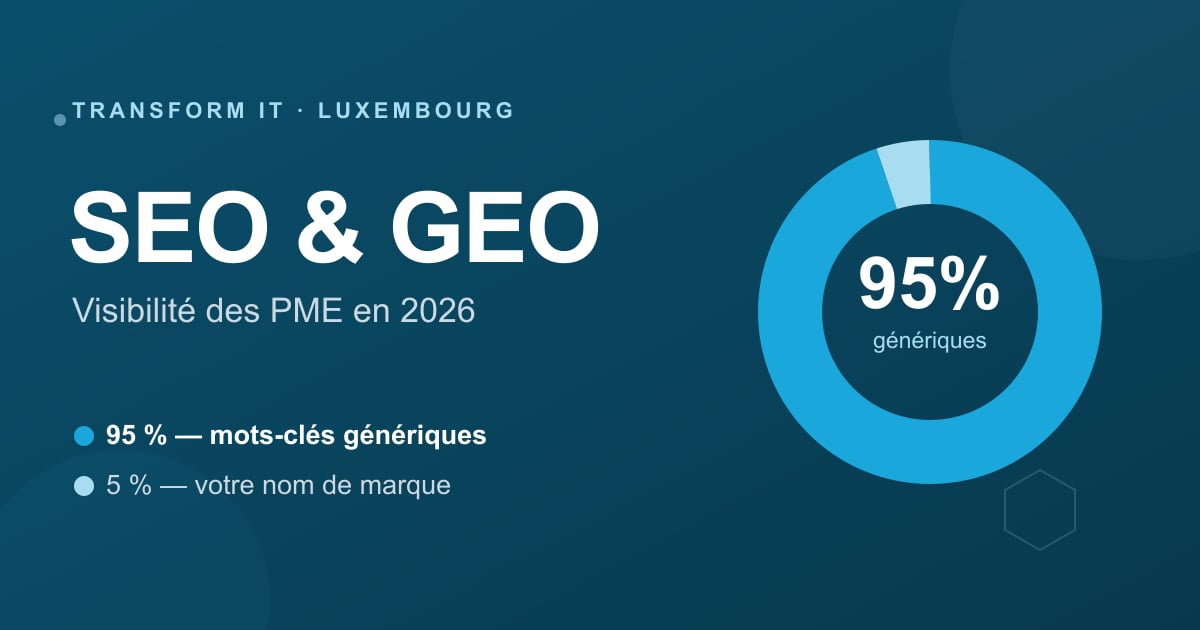
The principle is unforgiving: no one can search for a business they don't know exists. While your reputation is still being built, your prospects don't type your name — they describe their need. "Accounting firm Luxembourg", "company formation Luxembourg", "cross-border accountant", "web agency for SMEs"… all generic queries where your name appears nowhere.
Industry data confirms this imbalance for young brands: many primarily online businesses get only 3 to 5% of their search traffic from queries containing their own name. The rest — the overwhelming majority — comes from generic keywords. Conversely, a well-established brand with a strong physical or advertising presence can go much higher. The lesson is clear: the less known you are, the more your visibility depends on keywords.
The real playing field: keywords
Across all searches, recent studies (notably an analysis of nearly 150 million keywords) show that searches containing a brand name account for around 45% of total volume. In other words, even in aggregate, more than half of all searches are generic. And for a starting SME, this proportion climbs even higher: almost all of your potential visibility plays out on queries where you compete openly with everyone.
This is precisely where search engine optimisation (SEO) comes in: structuring your site, your content and your local presence to appear on these high-intent generic queries — the ones typed by prospects who don't know you yet, but who have exactly the need you can address.
2026: search is shifting towards AI
A second shift is changing the game. Search is no longer Google's monopoly. Increasingly, your prospects ask their questions to AI assistants — ChatGPT, Perplexity, Gemini — or read AI-generated summaries directly in search results. They discover solutions through these synthetic answers, and only search for your name afterwards, once you've been mentioned.
This gives rise to a new discipline: GEO (Generative Engine Optimization), optimisation for generative engines. The goal is no longer only to rank in a list of blue links, but to be the source the AI cites, summarises and recommends. This requires clear, structured, factual and authoritative content — exactly what AI models favour when building their answers.
SEO + GEO: one strategy, two fronts
SEO and GEO are not opposed, they complement each other. SEO captures existing demand on traditional engines. GEO positions you where search is heading: generative answers. Both rest on the same foundations — a fast, well-structured site, quality content that answers real questions, and a consistent local presence.
For a Luxembourg SME, the stakes are concrete: until your name is known, keywords and AI citations will bring you your first clients. Investing early in SEO and GEO means building visibility that works for you continuously, long before people think to type your name.
In summary
Don't bet your visibility on a reputation you don't yet have. A young brand becomes known through keywords and, now, through AI answers. SEO and GEO are not options: they are the levers that turn strangers into clients.
Want to know where your company stands on Google and on AI engines? Transform IT runs an SEO/GEO audit of your online presence and proposes a concrete action plan. Get in touch.